 en
en Tiếng Việt
 日本語
日本語 简体中文
简体中文 한국어
한국어
As businesses attach ever more importance to food safety and place it at the top of their priority list, suppliers that meet quality requirements are always highly valued. Having a full set of safety certifications such as HACCP, which helps identify and control hazards affecting consumer health, has therefore become a mandatory condition.
For industrial kitchen systems in particular, the HACCP standard plays an important role in keeping potential risks to a minimum. Join STAVI in taking a closer look at HACCP certification for industrial catering and canteens, and the practical benefits this standard brings to businesses.
.webp "The HACCP standard is very important for industrial catering")
The HACCP standard is very important for industrial catering
Read more:
- STAVI suggests quality 25k factory menus for 2026
- Price list and menus for industrial, school and office catering, June 2026
- STAVI tightens control over input food quality
What is HACCP certification?
HACCP (short for Hazard Analysis and Critical Control Points) is a quality management system based on identifying, assessing, preventing and controlling hazards that may affect food quality throughout the entire process from production to consumption. Developed in the 1960s, HACCP is now a key international standard widely applied across the food and beverage industry, including canteens and industrial catering production facilities.
HACCP certification is a document issued by an independent certification body confirming that a business strictly complies with food safety control principles, from input ingredients to the finished product consumed at the final stage. Achieving HACCP certification demonstrates a company's ability to control food safety across its supply chain, from input ingredients to the production process, and to meet the stringent requirements of major partners.
The role of the HACCP standard in industrial catering
In the industrial catering sector, quality and food safety always come first, as even a small error in cooking or operations can lead to serious consequences. The importance of the HACCP standard in the industry is therefore undeniable, and it is applied by industrial catering providers today. The most notable roles of the HACCP standard in industrial catering include the following.
Ensuring food safety
HACCP goes deep into effectively controlling biological, chemical and physical hazards during food processing. Every stage, from ingredient selection, pre-processing, cooking and storage to transport, is closely monitored according to standard procedures.
As a result, the risk of food being contaminated by bacteria or chemicals, or containing foreign objects, is minimized, ensuring that every meal reaching the consumer is safe and of good quality.
Preventing food poisoning
HACCP helps identify the agents that cause food poisoning during production, so that food safety risks are blocked from the very start. A food poisoning incident at a factory or industrial park can affect hundreds or even thousands of workers at the same time, with enormous consequences.
Proactive prevention helps catering providers minimize incidents related to food safety and hygiene and avoid financial losses as well as damage to their brand image.
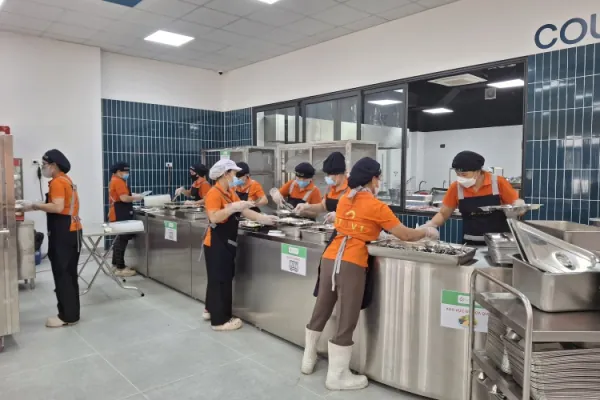
.webp "STAVI prevents risks and improves meal quality through strict control at every stage")
STAVI prevents risks and improves meal quality through strict control at every stage
Improving meal quality
An effectively operated HACCP system helps keep the system safe and maintains consistent quality in every meal. Ingredients received at the kitchen are stored at the right temperature, cooked according to the right procedure and served at the right time, so they retain their flavor, nutritional value and freshness. This contributes to higher satisfaction among customers and those who use the catering service.
Enhancing the reputation of industrial catering providers
Businesses today increasingly prefer catering providers with a clear quality and food safety management system. Applying HACCP is proof of a company's professionalism and commitment to quality.
It is also an important competitive advantage that makes it easier for a company to reach major customers, domestic corporations and foreign-invested enterprises.
Complying with legal regulations
The food industry is closely regulated by the authorities, especially at a time when many food-related problems are occurring across school chains. Building and maintaining a HACCP system helps a business meet current food safety and hygiene requirements, while also making inspections, audits and customer assessments go more smoothly. In particular, in canteens such as schools, hospitals or factories, where thousands of meals are prepared every day, applying HACCP becomes all the more necessary to reduce the risk of food poisoning and hygiene-related problems.
The 7 principles of HACCP for industrial catering
Applying the 7 HACCP principles in industrial catering plays an important role in ensuring food safety, preventing food poisoning and improving meal quality for workers. These principles help a business comprehensively control hazards from the receipt of ingredients until the meal is served.
1. Conduct a hazard analysis
An industrial catering provider needs to identify the hazards that may arise during production, such as bacteria, viruses, chemical residues in food or foreign objects such as metal, plastic, hair, etc. Food safety hazards can be divided into four types: physical hazards, chemical hazards, allergen risks and microbial contamination. Fully identifying the risks is the basis for building effective control measures, so that each hazard is eliminated right from the first step.
2. Determine the critical control points (CCPs)
After the hazard analysis, the business needs to determine the critical control points in the food handling process; these are the last steps at which it is possible to intervene to eliminate a hazard or reduce it to the lowest level. For industrial kitchens, CCPs are usually found in ingredient storage, meal preparation, post-cooking storage methods, food sample retention and meal transport before reaching the consumer. If this step is not carefully controlled, it will lead to an unacceptable level of risk.
.webp "The 7 HACCP principles play an important role in industrial catering")
Following the 7 HACCP principles in industrial catering to ensure meal quality
3. Establish critical limits for each CCP
Each critical control point needs specific limits, such as food storage temperature, cooking time or sample retention time. These serve as the basis for assessing the level of safety at each stage of production. This principle prevents, eliminates or reduces hazards to an acceptable level. To establish critical limits, there must be a criterion that determines when a product moves from safe to unsafe.
4. Establish a monitoring system
The parameters at each critical control point must be tracked and recorded regularly and kept under tight control. Monitoring helps detect deviations in the production process early, so that timely action can be taken to ensure meal quality.
5. Establish corrective actions
The fifth principle requires the provider to establish corrective actions to be taken when a critical limit is not met. When indicators are found to exceed the permitted limits, the business must immediately take corrective measures, such as discarding substandard ingredients, adjusting the cooking process or stopping the use of food that is not guaranteed to be safe.
6. Establish verification procedures
The HACCP system needs to be checked and evaluated periodically to confirm that the control measures are working effectively. Verification helps the business continuously improve its processes and raise the level of food safety.
7. Establish record-keeping and documentation
All quality control activities, monitoring results, corrective actions and related documents must be fully archived. These are important evidence of HACCP compliance and also support traceability whenever required.
Fully applying the 7 HACCP principles helps industrial catering providers proactively prevent food safety risks, reduce the risk of mass food poisoning, improve meal quality and increase customer trust. At the same time, it is also the foundation for a business to meet legal requirements, strengthen its competitiveness and develop sustainably in the industrial catering service industry.
At STAVI, food safety is always regarded as a core element of our industrial catering operations. We maintain a full set of legal documents, food safety and hygiene certificates and other related documentation in accordance with current regulations. At the same time, STAVI applies a food safety management system based on the HACCP standard across the entire process, from ingredient selection, storage and cooking to meal transport and service. Tight control of the critical points helps minimize food safety risks, prevent the risk of mass food poisoning and ensure that every meal is of good quality, safe and fully nutritious. This is also STAVI's commitment to delivering quality meals that help protect workers' health and improve their productivity.