 en
en Tiếng Việt
 日本語
日本語 简体中文
简体中文 한국어
한국어
Food safety and hygiene in schools plays an important role in the health and development of students. To ensure that food in schools meets safety standards, the Ministry of Health and the Ministry of Education & Training have issued strict regulations on food preparation, storage and distribution. Properly implementing these regulations helps prevent the risk of food poisoning and related illnesses.
1. What is food safety in schools?
Food safety in schools means ensuring that the food used in a school is safe and does not harm the health of students and staff. This includes controlling the origin of food and the processes of preparation, storage, transport and distribution in order to prevent the risk of bacterial contamination, food poisoning and food-borne illnesses.
Ensuring food safety in schools helps protect students' health, enables them to develop well both physically and intellectually, and contributes to building a healthy educational environment by raising the quality of school meals. Recognizing the importance of food safety for students, the government has now issued many documents with detailed regulations on this matter. Every school therefore needs to understand the contents of these documents clearly in order to apply them correctly and avoid unwanted incidents.

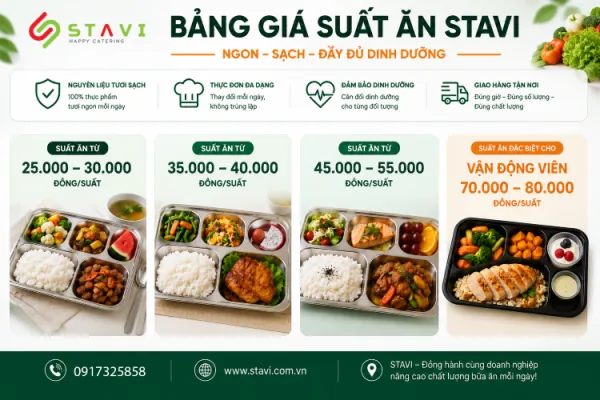
School meals at a STAVI kitchen
Read more:
- School catering company – The solution for quality meals for students
- School catering - the role and responsibility of the provider
- School meals for obese children
- STAVI - The leading school catering provider in Hanoi
2. Regulations on food safety in schools
The main regulations on food safety in schools are set out in Circular 46/2010/TT-BYT promulgating the National Technical Regulation on hygiene for the prevention of infectious diseases in educational institutions within the national education system, and Joint Circular No. 13/2016/TTLT-BYT-BGDĐT on school health work, which includes the conditions for food safety in schools. Below are some of the key points:
2.1. Regulations on the origin of food
Food must have a clear origin and be certified as safe.
Food suppliers must hold a certificate of eligibility for food safety.
Food of unknown origin, spoiled food or food past its expiry date must not be used.
2.2. Regulations on food storage
Fresh food must be stored in freezers or refrigerators.
Dry food needs to be stored in a dry, cool place.
Storage utensils must be kept clean, avoiding cross-contamination between raw and cooked food.
Regular checks must be carried out to remove spoiled food.
.webp "The food in every school meal must always be fresh")
The food in every school meal must always be fresh
2.3. Regulations on food preparation
The preparation area must be clean and comply with hygiene standards.
Food handlers must be trained in food safety and undergo periodic health checks.
Preparation utensils must be cleaned regularly and used separately for raw and cooked food.
Food must be cooked thoroughly to ensure safety.
Educational institutions must have a water supply and drainage system and hand-washing areas that meet standards.
2.4. Regulations on food distribution and consumption
After preparation, food must be stored and consumed within the prescribed time.
Leftover food needs to be disposed of properly to avoid unsanitary conditions.
Students need to be instructed to wash their hands before eating.
Food must come from reputable suppliers, with a three-step food inspection regime and food samples retained for 24 hours.
2.5. Food safety supervision and inspection
Schools coordinate with health authorities to inspect kitchens periodically.
Meals must be checked before distribution.
When violations are detected, timely corrective measures must be taken.
Students are encouraged to practice good personal hygiene, such as washing hands with soap.
3. Conditions for ensuring food safety in schools
3.1. Dining hall and canteen facilities
Dining halls and canteens must be well ventilated and adequately lit.
Windows need to be fitted with screens to keep out rats, flies, cockroaches and other harmful insects.
3.2. Structure and hygiene of kitchen and dining areas
Walls, ceilings and floors must be smooth and even, with minimal grooves and corners, to prevent dirt build-up and allow easy cleaning and disinfection.
Tables, chairs, utensils and equipment must be made of materials that are easy to wash.
Adequate equipment must be available for cleaning and disinfection.

A school kitchen system must follow the one-way flow principle
3.3. Food storage utensils and equipment
Food containers and eating utensils must be made of safe, easy-to-clean materials that do not leach harmful substances.
Appropriate food storage equipment must be available.
3.3. Clean water system and personal hygiene
There must be a clean water supply system that meets food safety requirements.
Hand-washing facilities with soap or sanitizer must be provided.
3.4. Handling waste and leftover food
Equipment must be available for sorting, collecting and transporting waste and leftover food.
Waste containers must be sturdy, have lids and be easy to clean.
3.5. Health and hygiene of service staff
Service staff must undergo periodic health checks, including a stool culture at least once a year.
When serving, staff must always follow the rules, wear kitchen uniforms and wear gloves and masks at all times.
3.6. Food safety assurance procedures
The kitchen must have contracts with suppliers of safe food.
The three-step food inspection regime must be fully implemented and food samples retained for 24 hours.
Complying with food safety and hygiene regulations in schools not only protects students' health but also helps raise the quality of education. Schools, parents and the authorities need to work closely together to ensure that school meals are always safe, helping students grow up healthy and well-rounded. If you are looking for a provider of school catering, please contact STAVI's hotline 0917 32 5858 for detailed advice. STAVI is proud of its 10 years of experience in providing school catering that is Delicious - Clean - Nutritionally complete.