 en
en Tiếng Việt
 日本語
日本語 简体中文
简体中文 한국어
한국어
Industrial catering is understood as meals designed for workers and staff at offices, companies, enterprises or industrial parks, with a set portion size and process based on a signed contract at a reasonable price, while still following nutritional standards and ensuring food safety and hygiene.
Understanding STAVI's quality-standard industrial catering management process
Industrial catering is usually produced on a large scale, so in order to manage and control the input ingredients used to produce the meals as well as the quality of the output, STAVI uses a number of highly effective industrial catering management methods. So what is that industrial catering management process?
STAVI's industrial catering management process
Depending on each business owner's management style and operating model, each company will manage industrial catering in different ways. Every management method a business owner adopts aims at service quality and building the brand's reputation with valued customers. Below is the industrial catering management process that STAVI has been applying at a number of its facilities.

Image: STAVI industrial catering management process
Learn more about STAVI, the industrial catering provider
Learn in detail about the industrial catering production process at STAVI
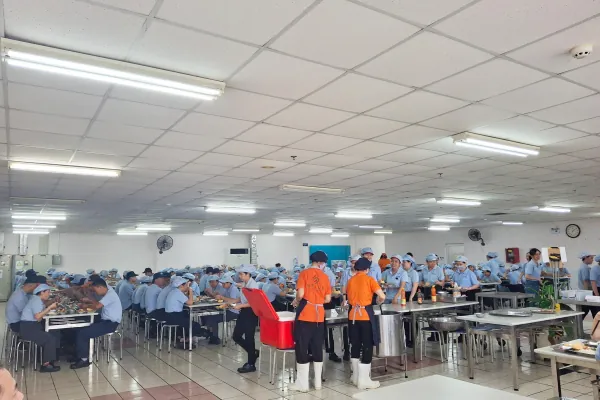
1. Managing industrial catering with the self-service model
In this model, once the dishes are cooked they are laid out in large trays; diners can help themselves, or a kitchen staff member will help serve food according to each person's needs.

Image: The self-service industrial catering model is popular
After the meal, leftover food is collected, sorted and handled by kitchen staff following a process that ensures food safety and hygiene. This model is very complicated to manage because businesses sometimes cannot strictly control the amount of food per diner. There may be shortages or, at times, surpluses that cause losses and waste for the company's operations.
You may also want to read some articles that many other readers are interested in
2. Managing industrial catering with the served model
This model is more widely used today: after cooking, the food is divided in advance into equal portions matching the number of diners. Kitchen staff time the portioning so that the meals are served hot and contain all the nutrient groups diners need most.
.webp "Managing industrial catering with the served model")
Image: Managing industrial catering with the served model
This model helps businesses control the amount of leftover food after each meal. In addition, when operating under this model, businesses do not need to spend time and manpower serving food to diners, which both avoids disorder in the canteen and gives people time to rest after each working session.
3. Managing food inputs
A standard-compliant industrial catering meal, both fully nutritious and safe and hygienic, must be prepared under a closed-loop industrial catering management process, starting with managing food inputs.

Image: Managing food inputs
For a delicious meal, the prerequisite is that the food supply must be fresh and clean. That is why selecting and managing the food inputs is an extremely important step. The food used must not only be fresh and tasty but also of clear origin.
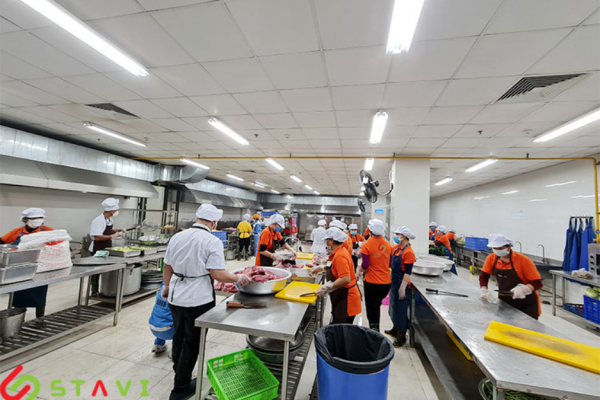
4. Managing the industrial catering preparation process
Here, every stage of food preparation, from cleaning and cooking to packaging, must be carried out in dedicated kitchen areas to ensure the highest level of food safety and hygiene.

Image: Managing the industrial catering preparation process
5. Managing the industrial catering delivery process
Once the dishes are complete, the industrial catering meals are delivered directly to workers and staff so that they can enjoy a hot meal.
Thus, with a closed-loop industrial catering management process, businesses can be completely reassured when choosing an industrial catering service for their workers and staff.

Image: Managing the industrial catering control and service process
Benefits of an effective industrial catering management process
-
Businesses select their own food suppliers in order to pick the freshest, best food to prepare for the cooking process.
-
Once preparation is complete, the food is sorted and moved to the preparation area to remove dirt and wash off any wilted, pest-damaged or rotten leaves clinging to the produce.
-
After preliminary preparation, the food goes to the cooking stage, where it is cooked by a team of qualified chefs and nutrition specialists.
-
The food is divided into individual portions according to pre-set serving sizes and quantities, so as to ensure the nutritional content workers need. During the supply of food to workers, there are periodic inspections by the catering provider and factory management to assess in practice whether the meals are suitable, and to adjust quantities and portions to best match the food safety standards set by the Ministry of Health.
A reputable industrial catering provider - STAVI
-
STAVI, an industrial catering provider in Hanoi, builds its kitchens to the one-way industrial kitchen standard, meeting food safety and hygiene standards. Kitchen staff must receive food safety and hygiene training and undergo periodic health checks.

Image: Reputable industrial catering provider STAVI
-
The food used for cooking must be fresh, tasty and safe. The preparation, pre-processing and cooking stages, kitchen utensils, food containers, pots and pans, and clean water must always meet food safety and hygiene standards, limiting nutrient loss during preparation and cooking.
-
With all their dedication, the chefs at STAVI always pay close attention to the flavour and nutritional composition of every portion, with the aim of giving our valued customers dedicated service and satisfaction.