 en
en Tiếng Việt
 日本語
日本語 简体中文
简体中文 한국어
한국어
For many years, the industrial catering industry has largely relied on manual or semi-automated management methods. Recently, however, the industry has begun to change dramatically thanks to the arrival of Industry 4.0 technology. Modern technologies such as automation, app-based ordering, AI, Big Data and IoT are being introduced into every link of the supply chain. Below is an overview of what happens when companies begin applying Industry 4.0 technology to industrial catering management.
Related articles:
- Food safety and hygiene standards in industrial catering services
- STAVI's new supplier evaluation process – the foundation of every quality meal
- A round-up of the hottest trending image-creation guides on ChatGPT right now – extremely detailed
The shortcomings of traditional catering management
Although traditional methods such as handwritten records, calculating and building orders in Excel, reporting via Zalo or using Google Docs can work reliably at a small scale, once the number of meals rises to thousands per day, their limitations become glaringly apparent.
Dependence on people leads to many risks
Most of the tasks in an industrial catering operation, such as recording meal numbers, planning menus, ordering ingredients, selling to customers or tracking inventory, are still performed manually by people. This leads to a number of problems that cause losses of goods and meals, such as:
- Errors in portioning and ingredient ordering are easy to make.
- Tracking meal consumption history by customer and by shift is difficult.
- Quality and food safety are hard to control, relying on sensory judgement with no early warning system.
- A lack of transparency, making it difficult to review when an incident occurs or traceability is required.
- When a system depends too heavily on people, a disruption in just one link affects every stage of the process.
High labour and operating costs
Under a traditional operating model, many processes require staff to work on them directly: from receiving goods, planning menus and issuing stock to stocktaking and selling meal tickets. This adds cost to many tasks that technology could now handle. In addition, it easily leads to a situation of too many staff but too little efficiency, especially when the company scales up.
Applying an integrated management software system automatically eliminates many manual tasks and reduces the burden on staff. At the same time, it synchronises data across departments so that everyone has end-to-end visibility of information.
Saving on staffing costs here does not mean cutting people; it means reallocating resources so that people can focus on the stages that require creativity and strengthen supervision to improve service quality.

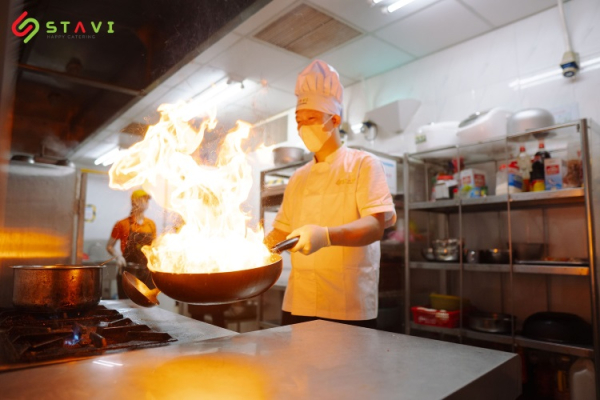
Applying Industry 4.0 to run industrial kitchens better
No basis for forecasting and data analysis
Most operators still manage with scattered, unconnected spreadsheets and fail to extract value from their data. Whenever an unexpected incident occurs, it takes a great deal of time to find the cause, as every stored file has to be reviewed. Moreover, data is stored in many different places, making service improvement slow and driven by gut feeling.
Without data to analyse consumption behaviour, companies easily fall behind the constantly changing needs of workers.
Lack of integration hinders scaling up
Each department in a traditional company typically operates independently with little close coordination, so when a review or incident response is needed, many problems arise. Information becomes fragmented, and incident handling and reporting are slow. Scaling up, when the company wants to serve more customers or additional locations, also becomes more difficult. Each rollout for a new customer means "starting from scratch", which is time-consuming and inflexible.
These issues not only affect operational efficiency but also carry the risk of damaged reputation and lost customers, holding back the company's growth.

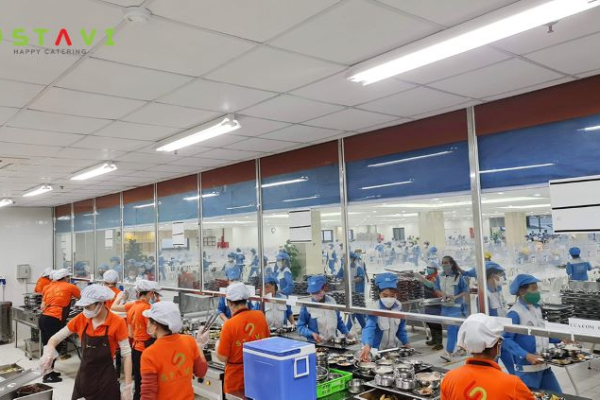
The industrial catering management process needs to be integrated
Industry 4.0 technology transforms the industrial catering industry
The Fourth Industrial Revolution is spreading rapidly into every corner of the economy, and the industrial catering industry is no exception. As a specialised production-service industry, applying Industry 4.0 technology is not just a trend but a matter of survival for enhancing competitiveness and achieving sustainable growth.
The development of core Industry 4.0 technologies such as IoT, AI, Big Data, Blockchain, smart management software, robots and labour-assisting machinery is opening a new chapter in industrial catering management.
IoT enables remote monitoring and timely alerts
Internet of Things (IoT) technology is opening up a new future for the industrial catering industry. Integrating IoT into catering management software brings many unexpected monitoring benefits. Sensors installed in cold storage, ingredient stores and preparation areas allow operations to be monitored, managed and controlled remotely. Managers can track and record temperature, humidity, storage time and other factors affecting food quality even when no staff are present. Continuously updated data makes it easy to detect and handle incidents (for example, a power failure in cold storage or a temperature that has not reached the required level).
Applying IoT can also help companies trace the origin and provenance of food, as each product is now tagged with a QR code or RFID tag. As a result, a product's QR code can be scanned to look up information, expiry dates and points to note.
Industrial catering management software
There are now many industrial catering software packages available, such as TAS-ERP, DigiStone, Vietnamsmart, ICMS, VNTS.VN and others. Each has its own strengths, and most help companies with a number of issues, such as:
- Automatically managing and recording meal orders by day and by shift from HR data.
- Managing menus and accurately calculating ingredient quantities for each dish.
- Integrating departments from accounting, warehousing and purchasing to financial reporting, giving the company an overall view and enabling faster decision-making.
- Querying and compiling meal statistics for specific periods from the database without wasting time searching.
- Managing the company's staff, arrival and departure times, reducing the workload of the HR department.
- Managing stock receipts and issues, so the purchasing department automatically tracks inventory and places orders early without manual counting by the kitchen.
Notably, some software can connect to a mobile ordering app, allowing users to choose from the menu and give feedback on meal quality, creating a personalised experience even in an industrial setting. Some of STAVI's office canteens are currently using this kind of software, allowing diners to book meal tickets in advance so they can wait for mealtime with peace of mind, without worrying about food running out or wasting time queuing.

Applying software and technology to catering management
Applying artificial intelligence (AI) and Big Data
AI makes unimaginable new advances every single day, which is why catering management software packages have also integrated AI for better management. At the same time, for business leaders, understanding and effectively applying artificial intelligence (AI) and Big Data to the catering industry brings many benefits, such as:
- Collecting user information and quickly and accurately analysing eating trends and preferences by season and day of the week.
- Forecasting meal numbers more accurately, reducing inventory and waste.
- Suggesting menu improvements that are both nutritious and appealing to the palate, avoiding repetitive dishes that cause boredom.
The combination of AI and Big Data not only helps the industrial catering industry run more efficiently, but also improves service quality, personalises the experience and enables smarter decision-making. In an industry with thin margins and high standardisation requirements like industrial catering, the company that harnesses the power of data will lead the game.
Blockchain – Bringing transparency to the food supply chain
Blockchain is a technology for storing and sharing data in chained blocks, where every piece of information is recorded step by step, cannot be altered or deleted, and can be accessed and verified by all stakeholders. When applied to the food supply chain, this technology delivers a high level of transparency, trust and safety.
- Every stage in the supply chain, from farming, harvesting and processing to transport and storage, is recorded on the blockchain, so consumers and companies can easily trace the origin of food
- It ensures transparency and prevents food fraud such as ingredient substitution, mislabelled expiry dates or purchasing goods of unknown origin, long-standing problems in the food industry.
- It increases the confidence of customers and partner companies through compliance with hygiene and safety standards.
Blockchain is no longer something remote; it has become a practical tool that helps the industrial catering industry build lasting trust, prevent fraud and guarantee absolute food safety.
Companies that take advantage of this technology early will gain a major edge in reputation, risk management and legal compliance, factors that are increasingly becoming a "passport" in the modern F&B industry.
Robots and automation free up labour
In kitchens serving thousands of meals a day, the pressure on speed, safety, consistent quality and operational efficiency is enormous. In recent years, the use of robots and automated equipment in the kitchen has become an inevitable trend, reducing reliance on manual labour, increasing consistency and saving costs over the long term.
Automated lines for washing vegetables, pre-preparation, portioning and tray packing save labour, speed up preparation and ensure food safety and hygiene. Below are some notable applications that have been and are being deployed in practice:
- Automatic industrial dishwashers
- Cooking robots: frying rice, stir-frying vegetables, frying eggs, etc.
- Precision food portioning machines
- Smart conveyor systems in the kitchen and at the delivery stage
Robots and automated equipment are no longer a "far-fetched" technology in the industrial catering industry. They are becoming powerful assistants in freeing up labour, standardising quality and creating a sustainable competitive advantage for companies pioneering digital transformation.

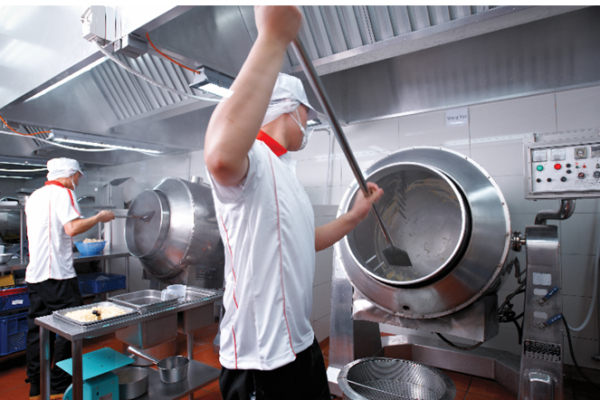
Using dishwashers in the kitchen to improve operational efficiency
Outstanding benefits of digital transformation in industrial catering
Applying Industry 4.0 technology delivers many concrete benefits in the industrial catering industry, including:
- Higher operational efficiency and shorter processing and delivery times.
- Lower ingredient waste costs thanks to accurate forecasting.
- Improved food safety, with better control and traceability.
- Optimised management of staff, shifts and meals by diner group.
- Greater transparency and professionalism, strengthening the trust of customers and workers.
Challenges on the digitalisation journey and how to overcome them
Digital transformation in the industrial catering industry is an inevitable trend, but the process is not always easy. Many companies, despite clearly seeing the benefits, still struggle with implementation due to factors relating to people, technology and operating culture. Although the potential is enormous, digital transformation in catering also faces plenty of obstacles:
- High initial investment costs (equipment, software, training).
- Difficulty changing the habits of the operating team.
- A shortage of staff who understand the technology and can operate the system.
- Scattered data and a lack of connection between departments
To overcome these difficulties and barriers, companies can adopt a step-by-step approach to becoming a pioneer:
- Run a pilot at a kitchen with a large meal volume, or with a promising customer, to evaluate effectiveness.
- Start with small steps, replacing processes gradually while training operating staff to understand the technology.
- Choose software and technology solutions "tailored" to the company's scale.
- Provide internal training and engage staff, helping them understand that technology supports rather than replaces them.
Industry 4.0 technology is not a "magic wand" that puts everything neatly in order with a single tap; it is a solution that helps each company improve its service quality. Applied correctly, it will help the industrial catering industry shift from reactive to proactive, from gut-feel management to smart governance, taking companies step by step towards growth and integration.
As customers demand ever higher standards of quality, transparency and efficiency, investing in technology is the inevitable path for any company that wants to affirm its position and grow ever more sustainably in the industrial catering industry.