 en
en Tiếng Việt
 日本語
日本語 简体中文
简体中文 한국어
한국어
Requirements you must meet to run a standard-compliant industrial catering business
What legal matters and conditions must businesses understand in order to run an industrial catering business effectively and lawfully? This is a question that many businesses just starting out care about and research carefully so that they can run an industrial catering business effectively. Explore the details with STAVI in this article.
Related articles:
- Stavi, the No. 1 trusted provider of industrial catering for factories and schools
- What is inside a standard-compliant industrial catering menu?
- Key criteria for evaluating standard-compliant industrial catering
- What nutrition does a standard-compliant industrial catering meal contain?
- Daily industrial catering menus that meet nutritional standards
Legal basis for running an industrial catering business
1. Decree 78/2015/ND-CP
Pursuant to Article 66 of Decree 78/2015/ND-CP on enterprise registration:
-
A household business is a form of business owned by an individual or a group of individuals who are Vietnamese citizens aged 18 or over with full civil capacity, or by a household.
-
It may register its business at only one location.
-
It employs fewer than 10 workers and is liable for its business activities with all of its assets. A household business employing 10 or more workers must register as an enterprise in accordance with regulations.
-
It must apply for a Food Safety and Hygiene certificate.
2. Civil Code 2005
Signing a contract to supply 1,000 meals to a company in an export processing zone is carried out in accordance with the "Civil Code 2015"; the two parties agree on the basic terms of the contract to secure the supply of meals, the sanctions applied if either party fails to perform the contract, and so on.
3. Decree 38/2012/ND-CP
Pursuant to Article 12 of Decree 38/2012/ND-CP and Article 9 of Circular 26/2012/TT-BYT, the establishments not required to obtain a Food Safety and Hygiene Certificate include:
-
Small-scale initial producers of functional foods.
-
Small-scale businesses with no special product storage requirements.
-
Street vendors.
-
Businesses selling pre-packaged goods that require no special storage conditions.
-
Businesses selling packaging and utensils that come into direct contact with food.
-
Pharmacies with a GPP certificate that sell functional foods and micronutrient-fortified foods.

Image: STAVI's food safety and hygiene certificate
4. Circular 26/2012/TT-BYT
Under Article 3 of Circular 26/2012/TT-BYT, the application dossier for the Certificate includes:
-
An application form for a Certificate of food safety eligibility.
-
The business registration certificate.
-
A valid copy of the personal identification documents of the business's legal representative.
-
Confirmation of food safety knowledge training for the owner of the establishment and the persons directly producing and trading food:
-
For establishments with fewer than 30 people: submit a copy of the confirmation.
-
For establishments with 30 people or more: submit the list of trained personnel.
-
-
A description of the facilities, equipment and utensils ensuring food safety conditions, including:
-
A layout drawing of the premises and the surrounding area.
-
A diagram of the food production process or the product storage and distribution process, and a description of the establishment's facilities, equipment and utensils.
-
-
Health certificates for the owner of the establishment and the persons directly producing and trading food; negative stool culture results for intestinal pathogens for persons directly producing food in areas where a diarrhoeal epidemic is circulating as announced by the Ministry of Health:
-
For establishments with fewer than 30 people: submit a copy of the certificate.
-
For establishments with 30 people or more: submit the list of health check and stool test results of the owner and of the persons directly involved in producing and trading food.
-
Issuing authority: the Sub-Department of Food Safety and Hygiene of the province or centrally-run city.
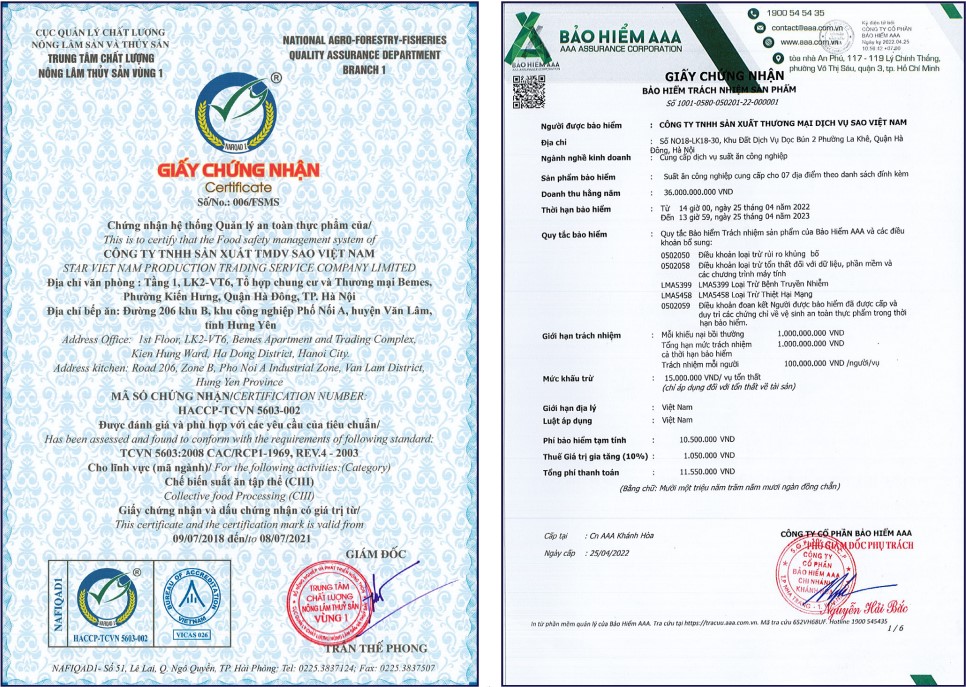
Image: STAVI's certificate
5. Law on Enterprises 2014
The Law on Enterprises 2014 governs the establishment, management organisation, reorganisation, dissolution and related activities of enterprises, including limited liability companies, joint stock companies, partnerships and private enterprises, and provides for groups of companies. It applies directly to the following:
-
Enterprises.
-
Agencies, organisations and individuals involved in the establishment, management organisation, reorganisation, dissolution and related activities of enterprises.
Food safety requirements for food service premises
-
The kitchen is laid out to prevent cross-contamination between raw and cooked food
-
Water samples meet the National Technical Regulation (QCVN) on domestic water quality No. 02:2009/BYT.
-
There are hygienic tools for collecting and containing garbage and waste.
-
Drains in the shop and kitchen areas must flow freely without stagnation.
-
The dining hall must be airy, cool and well lit, kept clean at all times, and have measures in place to prevent insects and pests.
-
There must be food storage equipment, toilets, hand-washing facilities, and daily, clean removal of waste and garbage.
-
The head of the unit operating the canteen is responsible for ensuring food safety.
-
Carry out three-step food inspection and keep food samples in accordance with the guidance of the Ministry of Health
-
Persons directly preparing food must have received food safety knowledge training certified by the owner of the establishment, and must not suffer from cholera, dysentery, typhoid, hepatitis A or E, infectious dermatitis, pulmonary tuberculosis or acute diarrhoea while producing or trading food.
Food safety requirements for processing establishments
-
Separate utensils and containers for raw food and cooked food.
-
Cooking and processing utensils must be safe and hygienic.
-
Eating utensils must be made of safe materials, washed clean and kept dry.
-
Comply with regulations on the health, knowledge and practices of persons directly producing and trading food.
Food safety requirements in food processing and storage
-
Food and food ingredients used must be of clear origin and safe, and food samples must be kept.
-
Food must be processed safely and hygienically.
-
Food on display for sale must be kept in glass cabinets or hygienic storage equipment that protects against dust, rain, sun and the intrusion of insects and pests, and must be displayed on tables or racks above the ground.
-
Equipment and vehicles for transporting and storing food must be hygienic and must not contaminate the food.
These are the insights shared by STAVI, and we hope the information above helps you clearly understand the legal information relating to the requirements for running an industrial catering business for workers.