 en
en Tiếng Việt
 日本語
日本語 简体中文
简体中文 한국어
한국어
As the industrial catering market demands ever higher food safety standards, applying international standards such as the ISO 22000:2018 standard and HACCP has become essential for businesses to operate their canteens safely, professionally and sustainably.
These certifications demonstrate capability and help businesses comprehensively control risks in the daily preparation and supply of food in large volumes.
Related articles:
- A guide to storing food safely in industrial kitchens
- STAVI holds prices and quality steady amid the “price storm”
- The role of scientifically designed menus for factory workers
I. What are ISO 22000:2018 and HACCP?
1. The ISO 22000:2018 standard
ISO 22000:2018 is the latest version of the international standard for food safety management systems. Developed and published by the International Organization for Standardization (ISO), this standard establishes a rigorous management framework for all food-related activities, from ingredient selection, storage, preparation and distribution to the delivery of meals to the end user.
The aim of ISO 22000:2018 is to help businesses assess and control hazards and ensure absolute safety for consumers. It prevents risks at every stage while establishing a mechanism for continuous improvement so that kitchen operations become ever more refined.

ISO 22000:2018 certificate of STAVI industrial catering
2. The HACCP standard
HACCP (Hazard Analysis and Critical Control Points), meanwhile, is a system for analysing hazards and controlling critical points. HACCP focuses on identifying the risks that may arise during food processing, such as microorganisms, chemicals and foreign objects, hidden throughout the entire food production and processing chain, from raw materials to the end consumer, to ensure that products are safe and do not harm health.
Critical control points (CCPs) are then established to prevent, eliminate or reduce hazards to an acceptable level for monitoring and prevention. It is a highly technical system and is regarded as the foundation of every international food safety standard.
This certificate is granted to a catering business when its food safety management system fully meets the requirements set out by the HACCP standard. Holding HACCP certification confirms that the business has successfully implemented effective measures to control hazards throughout the entire process, from production and preparation to meal distribution, thereby ensuring food safety for consumers.
By combining HACCP and ISO 22000:2018, a business builds a comprehensive food safety management system that is both managerial and deeply technical in nature.

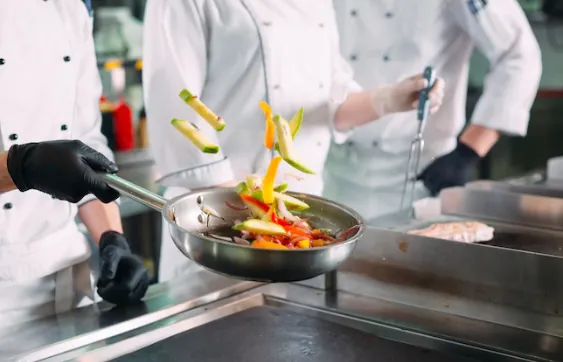
The HACCP standard focuses on identifying risks that may arise
II. The importance of the two standards for industrial catering
In the industrial catering industry, thousands of meals are prepared and served to customers every day. A single small mistake can therefore affect the health of many people and cause major damage to a business’s reputation and finances. Holding ISO 22000:2018 and HACCP certification thus plays an extremely important role in standardising food safety processes and minimising problems.
First, these two standards help ensure the highest level of safety for consumers, as the food preparation facility must strictly comply with and follow the regulations of both standards. Hazards are identified, controlled and continuously monitored throughout the kitchen’s operation. From receiving ingredients, preparation, cooking, hot-holding and transport to serving, every stage must meet clear standards. This minimises the risk of food poisoning and delivers safe meals, the very core of the industrial catering industry.
In addition, applying ISO and HACCP helps businesses build credibility and trust with customers. Today, most factories, especially FDI enterprises from Japan, Korea and Europe, require their catering partners to hold ISO or HACCP certification. This standardised system helps businesses pass periodic inspections with ease and gain a major advantage when bidding for catering contracts.
Moreover, the ISO 22000:2018 standard helps businesses stabilise their processes, minimise errors and reduce operating costs. When every process is built, controlled and clearly documented, businesses can easily detect faults, make timely adjustments and avoid unnecessary risks.
Thanks to these benefits, ISO and HACCP have become powerful competitive weapons, helping catering providers affirm their capabilities and establish their position in the market.
III. Why must businesses hold ISO 22000:2018 and HACCP?
For industrial canteens, holding these certifications is an almost mandatory requirement because:
First, the law requires food processing and trading establishments to apply food safety control measures. ISO and HACCP are widely recognised tools that fully meet the State’s requirements.
Second, customers that are large enterprises always place great importance on food safety. Many only sign contracts with providers holding ISO or HACCP certification, treating it as a “passport” for assessing a supplier’s capability.
Third, the industrial catering industry carries many high risks, from microorganisms and cross-contamination to errors in storage temperature. A single food poisoning incident can affect hundreds of workers and expose the business to very serious legal liability. ISO and HACCP help prevent these risks at the root.
Finally, applying these two standards enhances brand image and value, creating a competitive advantage over providers without certification.

STAVI kitchens hold all required safety and hygiene certifications
IV. Where to obtain ISO 22000:2018 and HACCP certification?
Businesses can register through reputable, state-recognised certification bodies such as:
1. Reputable certification bodies in Vietnam
QUACERT (Quality Assurance and Testing Centre): the national certification body under the Directorate for Standards, Metrology and Quality, Ministry of Science and Technology.
Vinacontrol CE: an organisation with a nationwide network across Vietnam, specialising in inspection and certification of food safety standards.
TQC CGLOBAL: an organisation designated by the Ministry of Science and Technology as competent to certify ISO 22000 and HACCP, at optimal cost for businesses.
KNA CERT: an organisation accredited by the Bureau of Accreditation (BOA) as competent to assess food safety management systems.
ISOCERT: provides training, assessment and ISO 22000 certification services.
2. International certification bodies (with offices in Vietnam)
If your business needs to export or requires the highest level of global recognition, you can contact:
BSI Vietnam: a long-established standards organisation from the United Kingdom.
SGS Vietnam: a world-leading group in inspection and certification.
DNV: an international risk assessment and certification organisation.
These organisations will assess the business’s management system and issue internationally valid, widely recognised certificates.
V. Process and procedures for obtaining ISO/HACCP certification
To achieve certification, a business must go through 6 main steps:
The process begins with a survey of the current state of the kitchen. The certification body or consultant conducts a preliminary assessment of the facilities, such as the preparation area, cold storage, main cooking area and operating systems, to determine how well they conform to the standard.
Next, the business builds its ISO–HACCP documentation system. This set of documents covers food handling procedures, critical control point management, personal hygiene rules, utensil sanitisation procedures, the traceability system and more. This is a key component that enables the business to run its kitchen to international standards.
The business then needs to train its staff. All employees, from the head chef to preparation staff, must clearly understand the procedures and know how to carry them out correctly according to the documentation.
Next comes the trial operation phase, lasting 1–3 months, to check the fit between the procedures and actual practice. During this time, the business must keep complete records, forms and logs.
Once the system has stabilised, the certification body conducts the official audit. Experts will check documentation, the kitchen site, the hazard control system, CCP monitoring records, environmental hygiene and more to determine conformity.
If the standard is met, the business is issued an ISO 22000:2018 or HACCP certificate, valid for 3 years and subject to annual surveillance audits.
What does a business need to prepare before applying for certification?
For the certification process to go smoothly, a business should prepare a number of important items in advance, such as:
- A kitchen floor plan following the one-way flow principle to avoid cross-contamination
- Cold storage, freezers and cooking equipment that meet the required standards
- Staff trained in food safety and hygiene
- Ingredient origin certification records and a list of reputable suppliers
- A three-step food inspection procedure and food sample retention
- Traceability documentation and quality control of input ingredients
- Management commitment to applying and maintaining the system
Thorough preparation from the outset saves the business time and money and shortens the path to certification.
Applying ISO 22000:2018 and HACCP brings enormous value to industrial catering businesses. These two systems help businesses control hazards effectively, ensure food safety, enhance their reputation and create a competitive advantage in the market. In an era where consumers pay ever more attention to health and meal quality, holding these two certifications is the foundation for sustainable growth and for meeting every stringent customer requirement.
STAVI industrial catering is proud to hold full ISO 22000:2018 and HACCP certification, affirming its food safety management capability under stringent international standards. Strict application of these systems allows STAVI to tightly control every stage, from ingredient selection, preparation and cooking to storage and meal distribution, in order to prevent and eliminate food safety hazards. This is STAVI’s firm commitment to delivering safe meals of outstanding quality that meet the high requirements of domestic and international businesses.