 en
en Tiếng Việt
 日本語
日本語 简体中文
简体中文 한국어
한국어
In recent times, many businesses have taken an interest in choosing industrial catering providers for their staff, rather than setting up a large canteen of their own, which takes a lot of personnel and cost. However, many businesses, lured by offers of "cheap meal packages" from facilities that do not fully carry out inspection steps, have run into a series of incidents such as food poisoning, skimpy portions and unappetizing dishes that leave workers unwilling to eat. So how to get industrial catering meals that both guarantee quality and meet the criteria of tasty - filling - never repetitive is a constant headache for many business owners!
An industrial kitchen management process is always designed tightly and methodically, from receiving goods and preliminary preparation to cooking, storage, food sample retention and customer service. For a company's kitchen areas to produce industrial meals efficiently, a close and rigorous industrial kitchen management process must be followed. A thorough understanding of the process helps the catering provider operate smoothly and minimize management risks. Let's learn about STAVI's "One-way industrial catering preparation process".
Read more articles:
- What is the nutritional portion of a standard-compliant industrial catering meal?
- STAVI's industrial catering implementation and management process
- Revealed: how to prepare delicious, clean and nutritious industrial catering meals
- Do you know the criteria for evaluating standard-compliant industrial catering?
STAVI'S ONE-WAY INDUSTRIAL CATERING PREPARATION PROCESS SYSTEM
Below is the diagram of the "One-way industrial catering preparation process system" that the STAVI industrial kitchen is operating effectively.
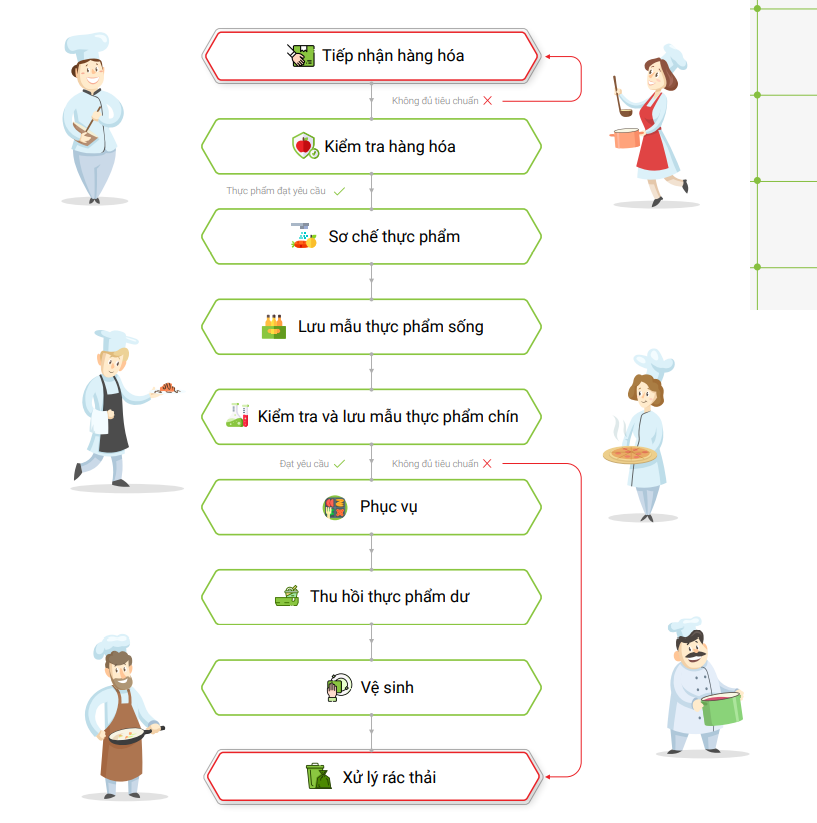
Diagram of the “One-way preparation organization system” at Stavi
1. How are the steps in the “One-way industrial catering preparation process” operated at Stavi?
Step 1: Receiving goods.
When receiving goods, we at industrial catering STAVI always pay attention to the following points:
-
Ensure that perishable foods are delivered by refrigerated truck. Check the temperature of the food on arrival to confirm it is still intact and fresh.
-
Food packaging must be intact, without breaks or punctures. If the packaging is damaged, the food inside must be checked, as it may be spoiled and unfit for consumption.
Step 2: Inspecting goods
-
Ingredients and cooking additives used in food production must have clear origin, be permitted for use under regulations and match the specifications in the contract between the two parties.
-
Check whether the quality of the fresh and dry foods delivered meets requirements. After inspection, goods that meet requirements are taken into the preparation and storage area. If ingredients fail to meet requirements, a report must be made and they must be returned to the supplier.
Step 3: Preliminary food preparation
After all steps of inspection for quantity and quality have been completed according to the process, the goods are taken into the preliminary preparation area. This is an extremely important stage that largely determines the quality of every dish.
-
For vegetables, tubers and fruits: pick over and clean the vegetables, peel, wash thoroughly; raw salad vegetables are soaked in salt water or cleaned and sterilized with an ozone washer.
-
For fresh raw foods: wash thoroughly and let dry, chop or cut into pieces, then cook. If not used immediately, these foods are placed in dedicated storage cabinets at the appropriate temperature.
-
For seasonings and dry, frozen and canned foods: sort and place them in their designated positions.
Steps 4 + 5: Retaining raw food samples and inspecting and retaining raw food samples
-
All food cooked during the day must have samples retained. A minimum of 100g is taken for solid food and 150ml for liquid food of each type.
-
Food samples are taken and placed in dedicated containers, carefully sealed in accordance with regulations. Samples are taken before the food is served to customers and stored immediately after being taken.
-
Retained samples are labeled with full information: type of food, sample, time taken, person who took it, which meal, etc. Food labels must be waterproof, resistant to creasing and peeling, and properly sealed.
-
Retained food samples are stored separately from other foods to avoid confusion; the standard storage temperature is 2 - 8oC. The minimum retention time is 24 hours from the time of sampling and sealing.
-
Full information is recorded in the monitoring form and kept for at least 24 hours; samples are only discarded once no problems have arisen and no poisoning is suspected.
Step 6: Serving
-
After cooking, samples of the dishes are taken and retained for testing, checked from taste to color, and once confirmed safe, the meals are portioned out for employees according to the set portion sizes.
-
Meals are pre-portioned onto trays and distributed to employees at the company during shift breaks. Dishes are kept warm in dedicated stainless steel containers so that they are always hot and delicious.
Step 7: Collecting leftover food
Leftover food is collected daily to prevent odors and keep the kitchen area hygienic. At the end of each day, leftover food is collected by livestock farms. Make sure these leftovers are still clean and free of foreign matter when used as animal feed.
Step 8: Cleaning
-
We combine manual wiping and cleaning with modern machinery, equipment and tools, specialized chemicals, optimal methods and modern treatment processes… to bring the greatest benefit to the employees who use the facility and to the quality of every meal for our customers.
-
A comfortable, clean living and working environment that is safe for health is the most favorable condition for employees to concentrate on their work and give their all to the company.
Step 9: Waste treatment
-
Daily restaurant operations usually generate a large amount of wastewater and solid waste. Solid and hard-to-decompose waste is treated, separated by type and sorted for treatment. Grease is always the most common waste in restaurants, so the treatment process must include a grease treatment stage using a grease trap. Waste treatment usually costs a certain amount, so in the initial business plan you need to estimate in advance the cost of keeping the treatment system running.
-
One way to make waste treatment faster and cheaper is to sort waste at the source, that is, right in the kitchen and the restaurant's waste storage area. Using food economically and storing it effectively is also a way to reduce waste in the restaurant.
-
To run the restaurant business effectively and create a good impression on customers as a green restaurant, the restaurant owner needs to invest in building a waste treatment system and train staff in using environmentally friendly products and saving materials and fuel.
II. Conditions for a No. 1 standard-compliant industrial catering service
1. For the industrial catering meals
-
Dishes must be prepared from food of guaranteed, clear origin and provide sufficient nutrient content as required by the Ministry of Health.
-
Menus must be varied and change weekly, and must be sent to the customer for review and approval before implementation.
-
Dishes and flavors are changed regularly and not repeated, avoiding monotony and bringing freshness and novelty to diners.
-
Food must be inspected and samples retained in accordance with general regulations.
2. For staff
-
Kitchen staff uniforms must always be neat and clean, and should be changed every day. Hands must be washed carefully with disinfectant before preparing food.
-
Every industrial catering staff member must have knowledge of food safety and hygiene and be able to follow the correct processes for hygienic, safe food preparation.
-
Staff must undergo regular health checks, at least once a year. Eating, drinking and smoking are not allowed in the preparation area.
-
In the portioning area, staff should use serving tools to portion meals; hands must not be used for portioning.
3. Cleaning kitchen tools and equipment after cooking
-
The industrial kitchen and canteen areas must be cleaned daily to ensure food safety and hygiene during preparation.
-
Carry out regular overall hygiene supervision of the kitchen on a weekly basis or through unannounced checks.
4. For the company
-
Duties and functions must be clearly assigned for each specific job.
-
There must be coordination between the head chef, the manager, the main cooks, the storekeeper and the kitchen staff.
-
Train and guide staff to comply fully with kitchen rules and company regulations
-
Every week, evaluate and review the work results of each specific position.
-
All kitchen staff must receive training and testing on food safety and hygiene knowledge and undergo periodic health checks.
5. For the manager
To avoid regrettable incidents, food preparation must always follow set management processes, and the manager also needs experience and understanding of nutrition as well as food safety and hygiene, because these are large-volume meals serving many people at once, produced in professional, modern industrial kitchens with an emphasis on speed, efficiency and cost savings.
Because meals are made in large quantities and prepared quickly, mistakes are unavoidable. On the other hand, the manager needs to choose reputable industrial catering providers that guarantee quality and food safety and hygiene, and should not be tempted by low prices into ordering meals from substandard industrial kitchens that harm workers' health.

STAVI's qualified staff team
All of the above processes are carried out to create a standard-compliant industrial meal, improving efficiency through process and ensuring food safety and hygiene.
Please "CONTACT US NOW" at 0917325858 - 0911 32 5995 to have all your questions answered and receive advice on No. 1 standard-compliant industrial kitchen management solutions.
You may be interested in: